135. Peel your own image from the mirror
I have a wonderful friend, a great scholar, and, above all, someone who is almost on my wavelength in Ayodhya, the city of Ram.
However, we are far from the madding crowd that visits the town throughout the year, especially in the last two years, as the city has increasingly become a rich commercial hub of Hinduism and a gateway to heaven.
A belief is ingrained in the minds of Hindus worldwide that heaven will evade you if you neglect Ayodhya during your lifetime.
My friend, Dr. Raghuvansh Mani, is an English professor as well as a well-known Hindi poet and critic.
He is a highly respected scholar with extensive knowledge of topics ranging from Buddha to Marx to Gandhi and Ambedkar, as well as ancient and modern politico-religious practices.
This arc stretches long and ends at the doors of Charvaka Darshan, an ancient atheistic school of philosophy.
For those unaware, Charvaka rejects two of the four basic patterns of life: Dharm and Moksha. So, it doesn’t believe in the concepts of God, soul, the afterlife, and karma, and holds that Artha and Kama are the ultimate goals of life.
Recognised for advocating rationalism and critical thinking, it views the physical body as the self and sees death as liberation. It was a revolutionary philosophy that didn’t receive much acceptance and eventually died down.
Dr Raghuvansh Mani has a deep-rooted connection to Mauritius, as many of his relatives are settled there.
I believe they were part of an entourage of seven lakh people, mainly from Bhojpuri-speaking areas of Bihar and Uttar Pradesh, who arrived at the now-famous Aapravasi Ghat in Port-Louis harbour between 1834 and 1920. Recent data indicates that the descendants now make up two-thirds of the island's current population.
As some of his distant relatives were visiting the city, the professor was busy arranging things for his relatives. In the meantime, my air tickets were cancelled, so I thought of visiting a relative in Ayodhya.
I have not met him yet; meanwhile, my thoughts started drifting to those Caribbean writers who are essentially descendants of India, with Indian ancestry. There are many of them.
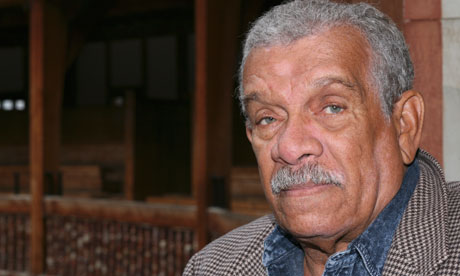
I remembered Sir Derek Alton Walcott, a contemporary of Sir V. S. Naipaul, and winner of the 1992 Nobel Prize in Literature, who has written some very personal poems, or, should I say, introspective poems.
When I met him, he asked for my year of birth. When I told him, he smiled and said, 'Oh, the year is important to me because I founded the Trinidad Theatre Workshop in that same year.'
He maintained strong ties to India through his ancestry.
He has eloquently recounted his experience of watching the Ramleela in Trinidad and has delved into Indian themes in poems such as “The Saddhu of Couva.”
‘For my spirit, India is too far,’ he writes in this poem; also, I remember a few lines –
“as the mosquitoes whine their evening mantras,
my friend Anopheles, on the sitar,
and the fireflies making every dusk Diwali.”
His epic poem, Omeros, is regarded as his most outstanding work, which I haven’t read.
I know less about his books; I’ve mostly heard and read about his sexual exploits rather than his creative work. And analyzing all those stories, Walcott appears to be a very complex man.
Harvard University adopted a formal sexual harassment policy only after a case involving Walcott, a visiting faculty member, who asked a student to sleep with him.
When she refused, he awarded her a poor grade, prompting an investigation by the university, which was eventually revised.
His name at Boston University appeared in relation to a sexual harassment case involving a student in Walcott’s creative writing program, which was resolved through a settlement.
In 2009, Walcott withdrew his nomination for the Oxford Poetry Professor position due to his widely discussed sexual exploits.
Some claim it was a ‘smear campaign’ against him, but the facts suggest otherwise.
We are not interested in what the great man did personally, as everyone is in the same boat without exception. However, it is undeniable that he is an excellent poet.
Here, I am sharing one of his poems, “Love after Love,” which I read after he passed away. I assume some friends may have forwarded it via email.
This short, lovely poem immediately caught my attention because I have written about this theme myself. It is a softly crafted poem that touches the heart with its straightforwardness and immediacy.
I believe life is beautiful and should be enjoyed fully; it is also important to pay attention to oneself. Maintaining an ongoing dialogue with the inner self is just as essential.
This poem examines this topic in depth and does so in a very subtle manner.
Read on -
The time will come
when, with elation
you will greet yourself arriving
at your own door, in your own mirror
and each will smile at the other’s welcome,
and say, sit here. Eat.
You will love again the stranger who was yourself.
Give wine. Give bread. Give back your heart
to itself, to the stranger who has loved you
all your life, whom you ignored
for another, who knows you by heart.
Take down the love letters from the bookshelf,
the photographs, the desperate notes,
peel your own image from the mirror.
Sit. Feast on your life.