235. I shall not live in vain
“If fame belonged to me, I could not escape her,” wrote Emily Dickinson in April 1862 to Thomas Wentworth Higginson, a literary critic.
Emily Dickinson (1830 – 1886) was one of the most prolific poets of the 19th century, but few in Dickinson's circle were aware of her writing until after her death, when her younger sister Lavinia discovered the collection of nearly 1,800 poems in her desk. Only 10 of her poems were published during her lifetime. Lavinia published her collection four years after her death.
Dickinson was a recluse, a rebel, and hated hypocrisy, conventions, and religious impositions. Today, her poems are recognized as groundbreaking with their short acerbic lines, which mainly deal with nature and mortality.
Eleven of Dickinson's poems were dedicated to her sister-in-law, Susan Huntington Gilbert Dickinson. She was in a relationship with her, and sent Susan Gilbert over three hundred letters
She wrote in 1852 to her, “Susie, will you indeed come home next Saturday, and be my own again, and kiss me as you used to? (...) I hope for you so much and feel so eager for you, feel that I cannot wait, feel that now I must have you—that the expectation once more to see your face again, makes me feel hot and feverish, and my heart beats so fast ( ... ) my darling, so near I seem to you, that I disdain this pen, and wait for a warmer language.”
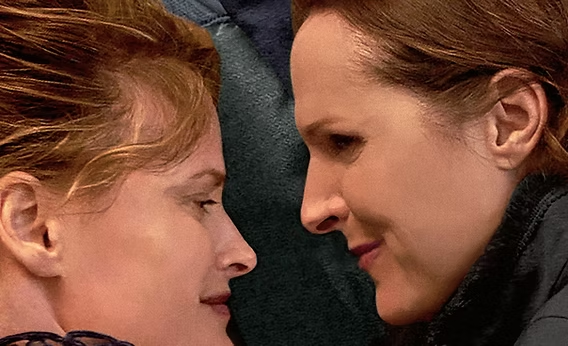
The American film Wild Nights with Emily is based on her life. A TV series Dickinson is also based on her life.
This morning, I was reading one of my favourite poems by her:
If I can stop one heart from breaking,
I shall not live in vain;
If I can ease one life the aching,
Or cool one pain,
Or help one fainting robin
Unto his nest again,
I shall not live in vain.