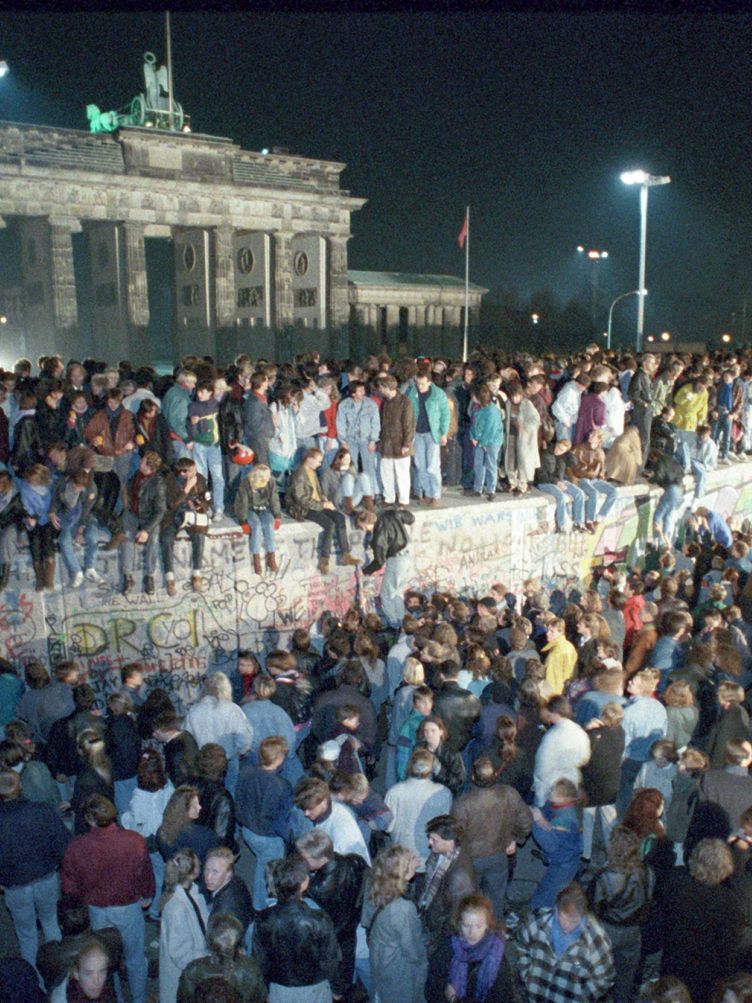
101. Remembering a night of celebration
Today was the day the Berlin Wall was opened after standing for 28 years, 2 months, and 27 days, dividing a city as a symbol of the Cold War.
It was a defining moment, something historical, a fact that the whole world knew would happen one day.
Until it actually happened, no one ever imagined that the Communist Party of Russia would collapse completely, and there would be Gorbachev and his perestroika.
But it happened and proved that a wall could never truly separate people.
From August 1961 to November 1989, a 155-kilometre-long concrete and barbed wire barrier, standing 3.6 metres tall, divided East and West Berlin.
Along its length, there were over 300 watchtowers and 20 bunkers, thousands of soldiers, guard dogs, alarms, and vehicle-trapping ditches.
Despite these preventative measures, numerous people tried to cross the wall, and over 130 of them died in the process.
So, it was exactly 36 years ago, on November 9, 1989, that the Berlin Wall was dismantled.
It was the day people like me, the staunch Communists around the world, didn’t sleep.
For us, it was a sad day.
We didn’t realize the impact of this because we were unaware of what was really happening on the ground.
Joseph Goebbels was long dead, but he had taken on a rebirth in different forms across the vast Russian Empire, which fed us with beautiful, incredible stories of a new world.
However, the idea and visualization of that world ultimately shifted when the curtain wall fell, not referring to the Berlin Wall.
A new world possessed all the infrastructure and essentials for everyone. However, over time, it began to crush people's dreams and lost sight of the belief that, beyond food and shelter, what humans need most is freedom — the freedom to express themselves, to enjoy the world's vibrant, ever-changing colors, and to explore an evolving, technology-driven world full of possibilities.
A BBC Journalist, David Lyon, based in East Germany, covered the protests that led up to the fall of the Berlin Wall, wrote back:
‘They were chanting ‘wir sind das Volk’ (we are the people), in response to the way in which the East German government had suborned public institutions and claimed authority over people, with the creation of organisations like the Volkspolizei. They were reclaiming that from the state. ‘You’re not the people, we’re the people.’
The fall of the wall changed Europe.
However, it is essential to revisit those days and examine a few pages of history, as well as to have a recap of why the wall was initially raised.
By February 1945, the outcome of World War II was largely determined, and Germany's defeat appeared increasingly unavoidable.
A conference took place from February 4 to 11, 1945, to develop the final war strategy against Germany and Japan and to determine Europe's post-war future at Yalta, a seaside resort known as Livadia Palace on Russia's Black Sea coast in Crimea.
It was the last wartime meeting of the 'Big Three' Allied leaders—British Prime Minister Winston Churchill, U.S. President Franklin D. Roosevelt, and Soviet Premier Joseph Stalin.
It was in Yalta that Stalin agreed to collaborate in establishing the United Nations Organization, a project very dear to Roosevelt's heart.
Not wanting to leave his other guest behind, as the host, Stalin called Churchill 'the man who is born once in a hundred years' and 'the bravest statesman in the world.'
Amidst the euphoria, Stalin issued a prophetic warning while responding to President Roosevelt's toast, which expressed hope that the unity of the Grand Alliance against Hitler would persist.
The Soviet leader replied: “It is not so difficult to keep unity in time of war since there is a joint aim to defeat the common enemy, which is clear to everyone. The difficult task will come after the war, when diverse interests will tend to divide the Allies. It is our duty to see that our relations in peacetime are as strong as they have been in war.”
That's so true. And we're all aware of the Cold War era.
Meanwhile, Allied forces had made substantial progress into Germany, and by April 25, 1945, Soviet troops had encircled Berlin, providing the Western Allies with a significant strategic advantage.
On May 8, 1945, Germany officially surrendered unconditionally to the Allies, marking the end of the European theater of World War II.
At Yalta, it was agreed to meet again, leading to the Potsdam Conference held from July 17 to August 2, 1945, marking the final gathering of the ‘Big Three’ Allied leaders.
However, before the Potsdam Conference, President Franklin D. Roosevelt had passed away on April 12, 1945, and Harry S. Truman had succeeded him as the new president.
At the Yalta Conference, Stalin was very determined to secure significant economic reparations as compensation for the destruction caused by Hitler’s invasion. Roosevelt agreed to convince Stalin to both join the war against Japan and participate in the United Nations Organization.
Truman decided to follow through on his predecessor's promise.
Midway through the conference, the results of the British general election were announced, and Churchill was replaced by the new Prime Minister, Clement Attlee.
Thus, only Joseph Stalin remained unchanged from the Yalta Conference. Moreover, the optimism and friendliness that were present at Yalta were also absent at Potsdam.
At the conference, it was decided that Germany would be occupied by the Americans, British, French, and Soviets. It would also be demilitarized and disarmed; the German defense industry would be dismantled; and the country’s educational and judicial systems would be purged of Nazi influence.
Additionally, Nazi racial laws and other legislation were to be repealed, and war criminals would be tried and punished. In the meantime, Germany was to be governed by an Allied Control Commission comprising the four occupying powers.
As there was no single victor, instead, three main victors, along with some allies, emerged, and everyone acted like vultures, eager to claim their share of Germany.
As a result, Germany was divided into four zones of occupation under the control of the United States, Britain, France, and the Soviet Union.
Berlin, although located within the Soviet zone, was also split among the four powers. The American, British, and French sectors formed West Berlin, while the Soviet sector became East Berlin.
The Soviet Union, differing ideologically from the other three, was an odd player in this game.
In 1949, Germany formally split into two independent nations: the Federal Republic of Germany (referred to as West Germany), which was aligned with the Western democracies, and the German Democratic Republic (GDR, commonly referred to as East Germany), which was aligned with the Soviet Union.
For three years, there was a kind of silence, but in 1952, the East German government closed the border with West Germany.
However, because the border between East and West Berlin was still open, East Germans could continue to travel through the city to access the more liberal and affluent West.
On August 12, 1961, a wire barrier was set up around West Berlin, and crossing points between the Western and Soviet sectors were closed, dividing neighborhoods and splitting families overnight.
Later, the barbed wire barricade was replaced by the Wall, which eventually grew into a fortified concrete structure encircling West Berlin and isolating it from East German territory.
On November 9, 1989, as changes unfolded within the Communist Party of Russia, a rush at the Bornholmer Strasse checkpoint led border guards to cease passport checks and let people pass freely in large numbers.
Thus, for the first time in 28 years, East Berlin residents could move freely into West Berlin, and celebrations erupted along the entire length of the Wall.
The official demolition of the Wall did not start until June 1990; however, by then, large sections had already been damaged or removed by souvenir hunters, who chipped away pieces of the Wall.
The fall of the Berlin Wall marked the initial step toward German reunification, which took place on October 3, 1990.
Today, Berlin, a lovely city with a rich history, is a city without a wall separating the East and the West.
And we, the hardcore Communists, sulked for a few years before accepting the historical development, and later embraced it wholeheartedly when we learned about the widely reported activities of East Berlin's oppressive regime.