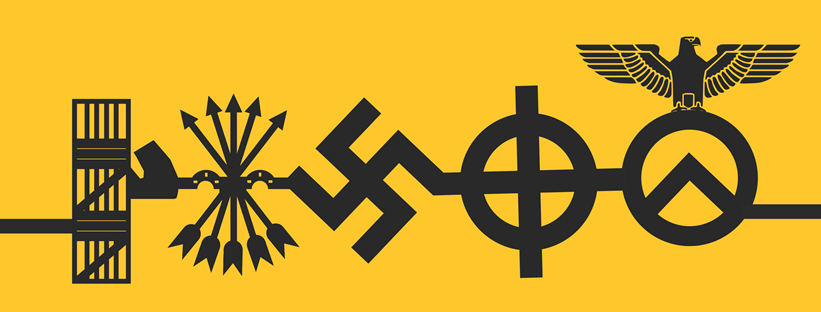
151. far right is increasingly infiltrating everyday culture
Currently, the far right is gradually increasing its presence across all areas of society, and no country is an exception.
Many assume that individuals join the far right because they genuinely believe in its ideology and seek like-minded others, but this is a misconception.
Extremist messages are now embedded in music and YouTube videos.
Two young children wearing ski masks and T-shirts featuring Nazi symbols appeared in a German video titled Balaclava Kitchen, which remained online for months before YouTube removed the channel for violating its rules.
However, it offered insight into how far-right groups have harnessed cultural production, including clothing brands and music, to normalize their ideas.
Initially, their capacity depended on the skills of their members, as they required musicians, artists, and camera operators to produce content. With the rise of generative AI, we now have technology that can produce images or videos instantly.
The connection between extreme ideas and cultural tools is often complex, as shown by a group of far-right extremists in the Netherlands who enjoy hosting wine-tasting events.
They are also supported by established institutions and prominent people in various fields.
Matthias Moosdorf, a 60-year-old member of Germany’s far-right Alternative für Deutschland party, has been involved in performing a Nazi salute in parliament.
He allegedly greeted a party colleague at the Reichstag building's entrance with a heel click and a Hitler salute. Moosdorf, a member of parliament, was well aware that the greeting was visible to others in the entrance area.
Performing such a salute is illegal in Germany and can lead to a punishment of up to three years in prison. That means he didn’t care about anything.
Moosdorf was a foreign policy spokesperson for the party’s parliamentary group before he was stripped of his parliamentary immunity and relieved of this duty.
In October this year, I read Prime Minister Giorgia Meloni of Italy’s autobiography, “I Am Giorgia: My Roots, My Principles.” It’s a candid memoir that details her working-class childhood, her rise in Italian politics, her family influences, her faith, and her experiences as a woman leader. She has also described her love of the fantasy genre: a world where heroic idealists embark on a quest against evil.
Few people are aware that the foreword is written by Prime Minister Narendra Modi, who described it as her "Mann Ki Baat" (thoughts from the heart).
After reading, I learned two important things: The Neverending Story, a complex novel by Michael Ende published in German in 1979, which explores mysticism and the occult from multiple angles and resists a single interpretation. And its protagonist Atreju.
Atreju, the protagonist, was a favorite among Giorgia Meloni and her associates during their time at neo-fascist “hobbit camps” in the 1990s, where fantasy literature was used to make hardcore right-wing propaganda more palatable.
Now, Atreju is Italy’s largest right-wing festival, held annually since 1998 to promote patriotism and nationalism. Meloni was personally involved in organizing the first event.
‘Atreju’ is not a political party conference but a community gathering that focuses equally on myth creation and politics.
At this year’s event, held earlier this month, a different reality was revealed. Among the nativity displays and kitsch decorations were ads for nationalist newspapers and something called “patriot radio”.
A mural depicted a lineage stretching from the fascist poet Gabriele D’Annunzio to the late American MAGA influencer Charlie Kirk, and the crowd was composed of students, Gen-Z influencers, and civil society.
What can we say about this?
The Norwegian Center for Holocaust and Minority Studies, in collaboration with the Center for Research on Extremism, is spearheading a six-country initiative to study how the extreme right employs aesthetics—ranging from fitness influencers to memes and stickers—to disseminate its messages across Europe.
Researchers discovered that from Sweden to Spain, extremist messages were embedded within cultural elements of daily life, both online and offline. In Hungary, some extreme-right bands have become mainstream after reaching the top 40 chart.
Female content creators who endorse traditional gender roles on social media have increasingly obscured their content’s far-right roots. Despite this, the perspectives they share—ranging from anti-feminism to nostalgia for an idealized past—still advance far-right goals.
An idea never dies. That’s a fact. And in this age, when the so-called global village is shrinking due to the expansionist attitudes of countries like Russia and China, not to mention many others, it is high time to think it over.
If we have already seen the volatile and destructive outcome of a full-blown idea, it must be discarded. The world has space for new ideas.
So why stick to age-old dead concepts?