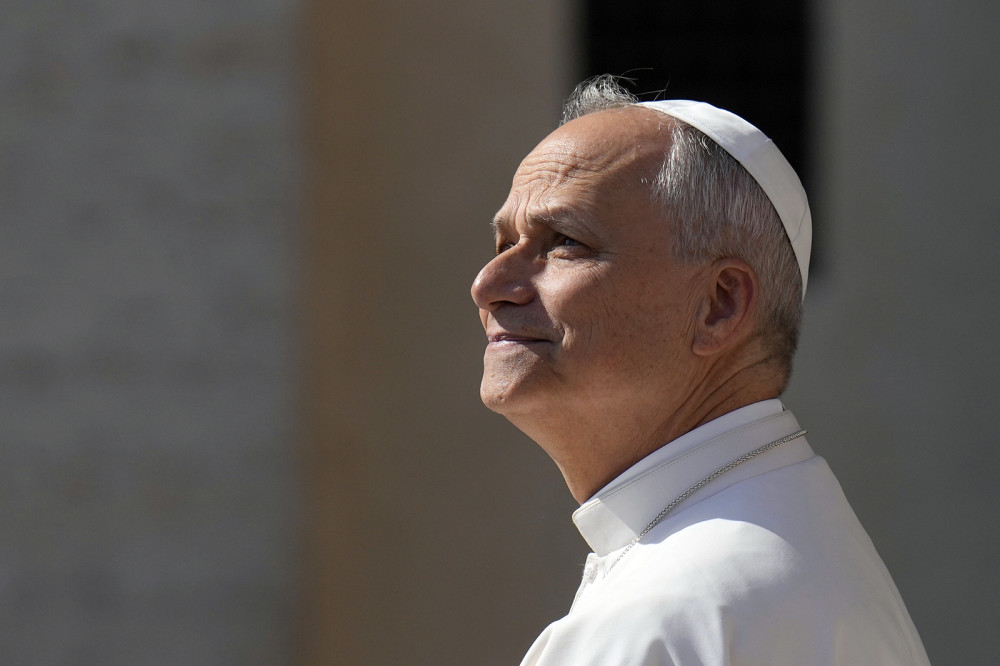
301. Pope Leo XIV is in tune with the times
Being an agnostic, I have never been a fan of any religious leaders, if we can call them that - the one with many followers, the head of a religion, a sect, or a math.
But ever since US President Donald Trump said some nonsense about Pope Leo XIV (born Robert Francis Prevost), I became curious to learn more about him. To me, if Trump dislikes someone, that person must be a man of some substance.
Recollect when Trump criticized Leo for being weak on crime and labeled him “terrible on foreign policy.” Meanwhile, his deputy Vice President JD Vance, a Catholic convert, advised the pope “to exercise caution when discussing theological issues related to war and peace.”
And all this despite the fact that Leo XIV is the first pope born in the United States, the first to hold U.S. citizenship, the first from the Order of Saint Augustine, and the second, after his immediate predecessor, Pope Francis, from the Americas.
I think he is the first modern Pope who speaks his mind without worrying about backlash and is in tune with the times, rather than merely a titular head appearing at events. I love this man for his comments.
He has been a high-profile critic of the war in the Middle East. “Today, more than ever, without prejudice to the right to self-defense in the strictest sense, it is important to reaffirm that the ‘just war’ theory, which has all too often been used to justify any kind of war, is outdated. Humanity has far more effective tools for promoting human life and resolving conflicts, such as dialogue, diplomacy, and forgiveness,” he said.
On May 15, in celebration of the 135th anniversary of Rerum Novarum, Pope issued his first encyclical, titled ‘Magnifica humanitas: On Safeguarding the Human Person in the Time of Artificial Intelligence.’ He calls for the protection of humanity, the promotion of truth, respect for the dignity of work, social justice, and peace.
Rerum Novarum was the inaugural encyclical released by Pope Leo XIII on May 15, 1891. It serves as an open letter to all Catholic bishops, addressing the challenges faced by the working class and examining the roles of labor, capital, government, and citizens. Additionally, the encyclical motivated Catholic activism.
Taking up the legacy of his predecessor by writing a social encyclical, Pope Leo XIV addresses one of the principal challenges of the contemporary age: artificial intelligence.
Divided into five chapters, Magnifica humanitas presents a core idea: technology isn't inherently antagonistic to humanity or evil. Yet, it is never neutral, as it reflects the traits of its creators, financiers, regulators, and users. Pope urges people to work towards the common good and stay human, fostering a courageous attitude of shared responsibility and community.
The first chapter, A Dynamic Approach Faithful to the Gospel, traces the development of the church's social doctrine. In the second chapter, Foundations and Principles of the Social Doctrine of the Church, he mentions five foundations: first, to uphold the dignity of the person and to call for concrete decisions in their favor in law.
The second is the inviolability of human rights, among which the first is the right to life “from conception to its natural end.” In this regard, he defines induced abortion, the killing of the innocent, and euthanasia as “choices that the Church considers gravely wrong”. The third foundation is the recognition of minority rights, with particular attention to women.
He says it is gravely immoral to subjugate a nation. He forcefully affirms that “the promotion of the common good can never be separated from respect for the right of peoples to exist, to preserve their own identity and to contribute their unique qualities to the family of nations. Therefore, any attempt or plan to eliminate or subjugate a nation is gravely immoral and therefore unacceptable.”
This is a message to both Donald Trump and Benjamin Netanyahu.
Solidarity is the fourth principle, described by the Pope as both “a principle and a virtue.” Social justice is the fifth principle of the Social Doctrine of the Church. He says that in the digital age, social justice requires ensuring fair access to opportunities for all people, protecting the most vulnerable, combating hatred and disinformation, and subjecting the use of technologies to public oversight. He identifies migrants, refugees, and displaced persons as a “litmus test” for social justice.
The way society treats migrants, he says, “reveals whether its sense of justice is driven by fear or by the spirit of fraternity.” He therefore appeals for societies to protect “the rightful hopes” of those forced to leave, by ensuring them safe and legal routes, dignified welcome, and genuine paths to integration, while promoting “the right to remain” in one’s homeland in peace and security, by addressing “the root causes” of migration.
The Pope says these five principles mean to listen to the “victims of spiritual, economic, institutional, sexual and power-based abuse, as well as abuses of conscience.”
The third chapter—Technology and Dominance. The Grandeur of Humanity in Light of the Promises of AI stresses the need to approach artificial intelligence with vigilance. He warns that the most powerful technology is not necessarily the best. AI can imitate and simulate a person, but it does not possess a moral conscience, empathy, or affective, relational, or spiritual capabilities. Pope insists on the need to ensure that technologies are not concentrated in the hands of only a few people, thereby widening the gap between those included and those excluded from the digital revolution.
AI must be “disarmed,” Pope continues, “to free it from the mentality of military, economic, and cognitive competition. To disarm does not mean rejecting technology, but preventing it from dominating humanity.” He says we must remember that “humanity flourishes not despite limitations, but often through them.”
In the fourth chapter—Safeguarding Humanity at a Time of Transformation. Truth, Work, Freedom—the Pope calls for an “ecology of communication” grounded in truth.
He urges transparency in content selection, protection of personal data, serious journalism grounded in argumentation and verification, a new awareness of the “proper and critical” use of digital tools, and the integration of different forms of knowledge.
He writes, “while AI promises to boost productivity by taking over mundane tasks, it frequently forces workers to adapt to the speed and demands of machines, rather than machines being designed to support those who work. Technology can certainly free human beings from burdensome or repetitive tasks, but it must not lead to unemployment in the name of reducing costs and increasing profit.”
Pope Leo then notes the need to move beyond GDP as the measure of a country’s development, focusing instead on the dignity of work, shared prosperity, reducing inequalities, and environmental protection.
In the fifth chapter—The Culture of Power and the Civilization of Love—Pope turns his gaze to war, saying, “The digital revolution is changing the nature of conflict and calls for an ethical approach, without which decisions about the life and death of persons will become increasingly impersonal due to the use of force regarded as an 'immediate and viable option.'”
Today, he says, public opinion is burdened by polarizing media narratives and by “a disconcerting loss of historical memory,” leaving people without a long-term vision. Consequently, he says, peace today is no longer understood as a task to be undertaken but as an interval between conflicts.
Pope Leo condemns the expansion of the arms industry, the nuclear arms race, and the rise of new armed groups—including jihadist organizations—who seek to sustain conflicts for power and profit.
He also cautions against AI-connected weapons, emphasizing that “there is no algorithm that can make war morally acceptable.” The Pope advocates for strict, globally recognized ethical boundaries based on personal responsibility and civilian protection. “Any technology that enables attacks without perceiving the face of human beings diminishes the moral standard of conflict.”
The Pope expresses regret that the rule of law has been supplanted by might, with power overtaking peace efforts, and that institutions meant to protect the shared future of nations have been weakened. He calls for “profound reforms” of the UN to address the current crisis of values and to promote the common good.
The encyclical observes that modern “hybrid” wars are now also fought on economic, financial, and cyber fronts, where disinformation and fear-mongering campaigns manipulate public opinion. This has resulted in increased military spending being viewed as the “only response” to an unpredictable future.
He observes that some might view armed conflict as a practical way to distract from internal issues and as a cynical means of handling challenges.
After reading those mammoth pages, what really stood out to me was his statement that “those who use the name of God to legitimize terrorism, violence, or war betray his true nature, for to fight in the name of religion means attacking religion itself.”
Islamic terrorists, jihadists, and far-right extremists should take note of the sentence.