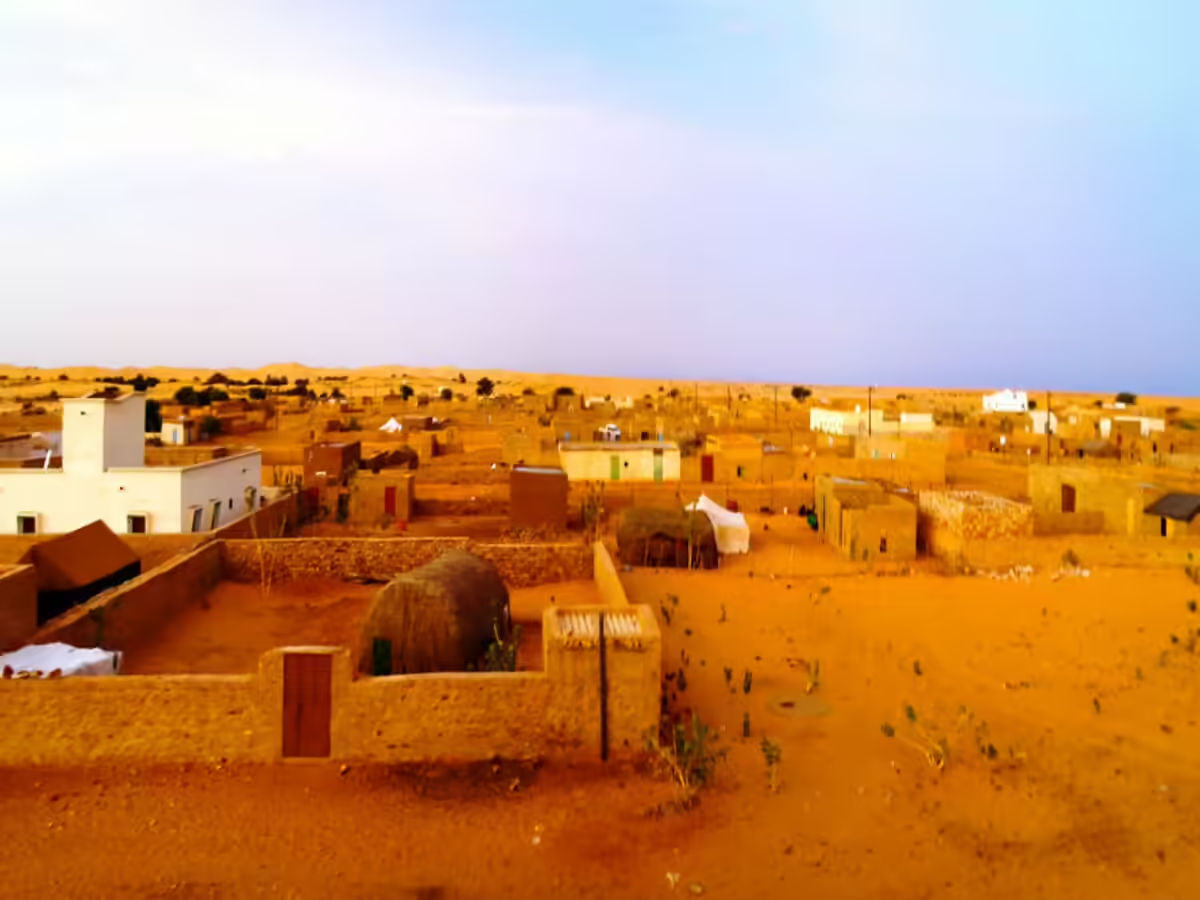
104. Chinguetti is Africa’s spiritual capital
Not many people might have heard about Mauritania, officially known as the Islamic Republic of Mauritania, a country situated in Northwest Africa.
A country whose name comes from Mauretania, the Latin term for a region in the ancient Maghreb, ranks as the 11th-largest in Africa and the 28th-largest worldwide.
In the late 7th century, a coalition of Arab tribes migrated to this area, introducing Islam, Arab culture, and the Arabic language. A colony of France, the country, achieved independence in 1960.
Since then, the country has faced repeated coups and times of military rule.
According to the 2018 Global Slavery Index, there are about 90,000 slaves in the country (or 2.1% of the population).
Islam is the official religion, and nearly all residents are Sunni Muslims.
However, this tiny desert settlement has something special—an essential feature not found anywhere else: libraries, unique in their kind.
One of its small towns, Chinguetti, is famously called the city of libraries. It was once an important stop for travelers and grew into a center for libraries that house religious and scientific manuscripts.
Chinguetti has historically functioned as a stopping point for caravans traveling along trans-Saharan trade routes. It later evolved into a hub for Maghreb pilgrims heading to Mecca. It gradually developed into a center of Islamic and scientific learning, earning nicknames such as the City of Libraries, the Sorbonne of the Desert, and the Seventh Holy City of Islam.
Although UNESCO recognises Chinguetti, this has not resulted in lasting financial assistance.
The town once had up to 30 family-run libraries, but this number declined due to harsh conditions, residents leaving, and a drop in tourist numbers.
In total, there are 12 family-run, red-brick libraries still in operation in the town. Together, they hold more than 2,000 volumes, including Quranic manuscripts and books on astronomy, mathematics, medicine, poetry, and legal jurisprudence from across the Maghreb and West Africa, dating back to the 11th century.
A town that must be saved.