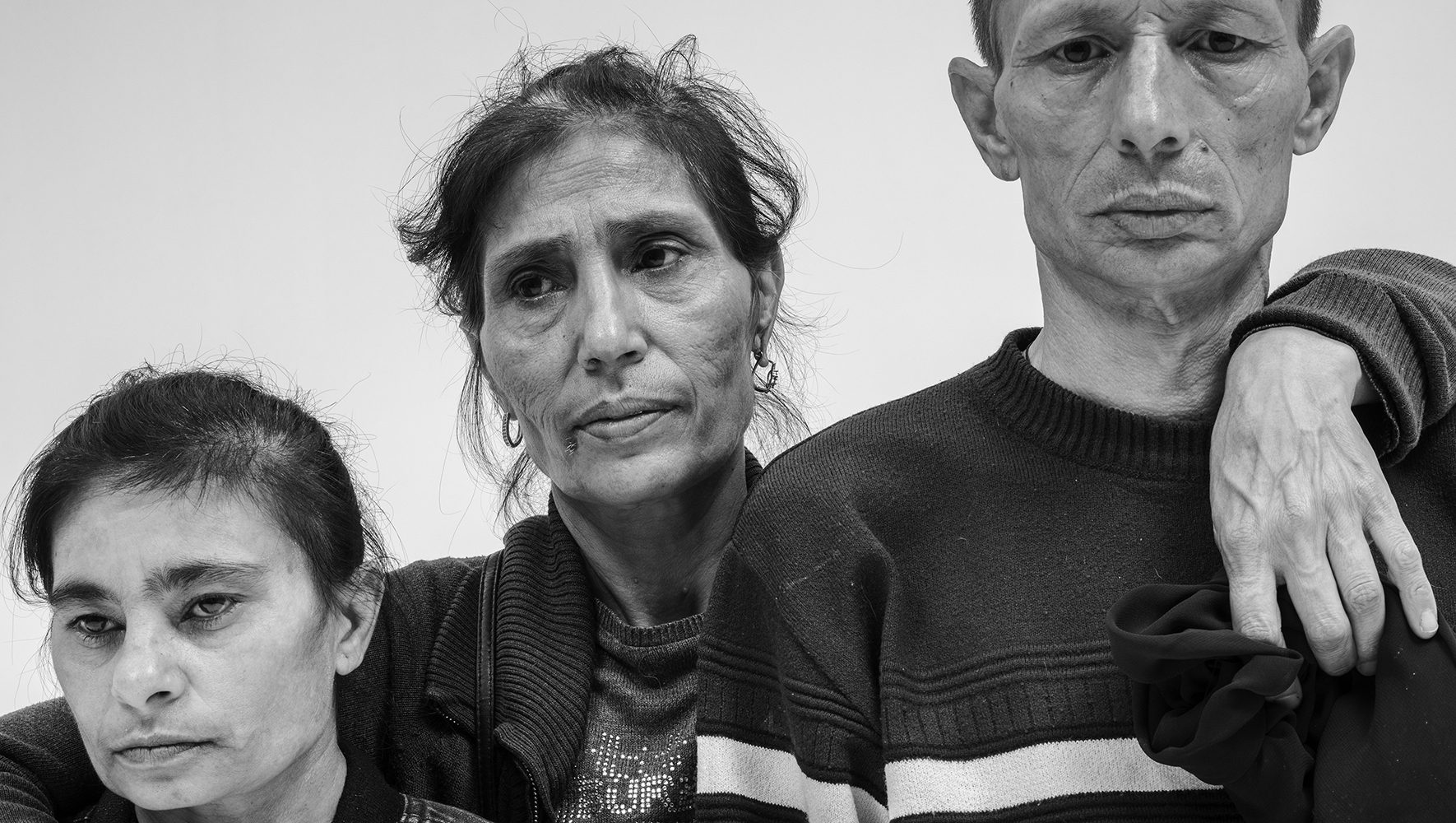
107. Janjali and his large family still sing those beautiful songs
I find the Romani people the most interesting because they understand how life should be lived.
Also known as Roma, they traditionally lead a nomadic lifestyle. Roma have a strong connection to India, and they are considered an Indo-Aryan ethnic group.
Currently, they are believed to be mainly in Romania, Bulgaria, Hungary, Serbia, and Slovakia. However, they are also found in India, particularly in the states of Uttar Pradesh and Rajasthan.
Linguistic and genetic studies suggest that the ancestors of the Romani people originated in South Asia, likely from areas such as Punjab, Rajasthan, and Sindh in present-day Northwest India and Pakistan.
Their northwestward migration happened in waves, with the initial wave likely occurring between the 5th and 11th centuries. They are believed to have first reached Europe between the 7th and 14th centuries.
I'm unsure whether that small number still resides in and around Lucknow, but I recall a large family visiting my village twice a year. We used to call them Kankali.
They used to travel with all their belongings, including dogs, buffalo, hens, and goats, along with everything else they owned.
These animals had a specific duty to carry out based on their size and strength because all their belongings were loaded onto them.
They would stay for a week and visit nearby villages, singing beautiful songs. People generously gave them rice, wheat, old clothes, and even money.
A face I remember fondly is Janjali's, a young man about 40, who had two wives. One was his wife, and the other was his elder brother’s abandoned wife, whom he married “because where else she could go."
They usually arrived in the evening, and Janjali would come to inform my grandmother of their arrival. Later, it was my mother. He knew us all by name and enquired about our well-being.
But his coming to inform had a silent message.
It was, “We are 10 members, and when the food is ready, please send someone to inform us so we can come and pick up our food.”
Yes, it was our duty to feed them that first evening.
They stayed outdoors under a tree with mosquito netting for all.
As children, our curiosity knew no bounds; we would gather around the area, sitting on the ground, watching intently as they built a home without walls or windows. Sometimes, we also took part in that ritual. Their dogs handled security.
It was a masterclass in careful planning and diligent execution.
The next day, Janjali would come along with his two wives, a Dholak hanging around his neck.
They would settle on our long porch and start singing. After two or three songs, they were served rotis, pickles, fruits, and other food items. The singing would continue for hours. In between, they would share jokes and talk about their extensive experiences over the past few months.
Before leaving our village, they would collect from each house whatever they could. If a marriage happened or a child was born in a family, they would ask for gifts – their 'neg,' as they called it. People treated them with so much love and respect that it's unbelievable these days.
Those Kankalis were the Romas or Romanis.
In English, the Romani people have historically been called Gypsies, but they don’t like this term because they find it offensive or a racial slur.
Roma were one of the groups targeted for persecution and murder by the Nazi regime before and during World War II because Nazis considered Roma to be racially inferior.
Germans frequently voiced complaints about them, calling for the deportation of the Roma to protect public morals, health, and security. These complaints prompted police to formally request Heinrich Himmler, the Reichsführer-SS, to deport the Roma to the east.
During the Nazi era, German authorities arbitrarily detained Roma, sterilized them, subjected them to forced labor in concentration camps, deported them, and carried out mass killings. Tens of thousands of Roma were murdered by German forces in the occupied Soviet Union and Serbia, with thousands more dying in the concentration camps.
.
German civilian authorities operated several forced-labor camps where Roma were imprisoned. The atrocities committed against the Roma went unrecognized across Europe in the decades following World War II.
German police authorities deported 5,007 Roma from Austria to the Jewish ghetto where they were confined in an apartment building within a segregated area. Within the first few months, hundreds of Roma died from a typhus epidemic caused by insufficient food, fuel, shelter, and medicine.
In December 1942, Heinrich Himmler ordered that Gypsies and part-Gypsies be sent to concentration camps. The estimated number of Gypsies killed by the Nazis is up to 500,000.
Approximately 21,000 Roma sent to Auschwitz died there.
Romanian military and police officials deported around 26,000 Roma in 1941 and 1942.
The authorities of the State of Croatia, another Axis partner of Germany, physically annihilated virtually the entire Roma population of the country, around 25,000 people.
The precise number of Roma killed during the Holocaust remains unknown. This uncertainty stems from the difficulty in determining the prewar Romani population in Europe, which estimates place between 1 and 1.5 million.
Based on the evidence available today, historians estimate that the Germans and their allies killed at least 250,000 European Roma during World War II. Some scholars believe the total death toll could be around 500,000.
In addition to the lives lost, numerous European Roma communities were destroyed. The Romani people suffered from psychological and physical trauma resulting from deprivation, abuse, and broken family ties.
As a result, reconstructing Roma cultural and social networks after the war proved to be extremely difficult.
I read a report stating that since the beginning of the war in Ukraine, approximately 7 million Ukrainian refugees have left for neighboring countries or farther west in Europe. At least 100,000 of them are Roma.
And so, a community that could have shown the world how life should be lived was almost wiped out, but not completely.
In my memories, Janjali and his large family still sing those beautiful songs, and I listen to their full-throated laughter.
(Top Photo: Roma refugees from Ukraine, courtesy of Karol Grygoruk/RATS Agency, with thanks)