209. Observe the Differences: Opposition Parties in Israel and India
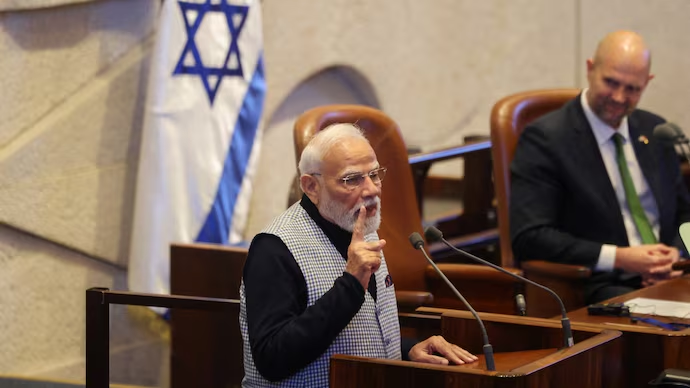
Prime Minister Narendra Modi starts a two-day visit to Israel today, February 25, 2026. The government states that the trip aims to reinforce the longstanding strategic partnership and offers a chance to address common challenges.
An upgraded security pact is expected to be a major focus. Additionally, the two nations are likely to finalize a free trade agreement later this year.
Modi will also deliver a speech at the Knesset (Israeli Parliament), and he will be the first Indian prime minister to address it.
The event is very important, given the geopolitical situation and India’s defence requirements, and it is also a courtesy visit to a friend after nine long years.
Israel is also involved with Iran, which is nearly at war with the USA. The people of Israel have suffered so much that even their atrocities attract sympathetic attention.
I feel anger, but I also recognize that many Jews around the world harbor deep-seated hatred and insecurity, which is understandable given that it has only been 80 years since the Holocaust occurred. So, even when I write in anger, I have a soft spot for them.
Israel has been a reliable friend to India, second only to Russia, and while it must support the country cautiously at times, it cannot abandon it.
The people of Israel are friendly toward Indians, and I can say this because one of my adopted daughters is married to an Israeli and has been living in Tel Aviv for the last two decades.
Their patriotism has no parallel in the world. Only the Rashtriya Swayamsevak Sangh belongs in this bracket. And this is a fact.
Mark the words of its opposition leader, Yair Lapid. He told the Knesset plenum that if war with Iran comes, “all differences of opinion will be put into deep freeze” until the conflict is over. Lapid affirms that Israel will remain united against any escalation with Iran.
“As in the past, I will mobilize for Israeli public diplomacy and to strengthen Israel’s international standing,” he declares. “As in the previous attack, I will go wherever necessary, from CNN to the British Parliament, and tell them: ‘You know that I am the head of the opposition, you know that Netanyahu and I are rivals, but Iran must be attacked with full force, and the rule of the Ayatollahs must be overthrown.'”
Remember that a moment before those comments, Lapid criticizes Netanyahu, stating that his historical legacy will be determined “only” by October 7.
“I understand the attempt to write a different history. You know the truth. That’s what scares you so much. History will only remember you for October 7,” Lapid says, referring to Netanyahu’s efforts to deflect blame for the devastating Hamas attack. “How you didn’t see where the suitcases of money from Qatar were leading. How you didn’t see where the wrong, destructive policy of strengthening Hamas was leading.”
Lapid also takes aim at the Prime Minister’s Office’s effort to remove the word massacre from a bill commemorating October 7, stating that “when babies are burned, when entire families are murdered in a mass murder, it’s not an event, it’s a massacre. There will be no stronger or more significant association, nothing else that will define your term as prime minister, other than the October 7 massacre.”
Israeli Prime Minister Benjamin Netanyahu said that Israel is navigating “complex and very difficult” days, signaling growing concern over rising tensions with Iran and the prospect of a broader confrontation.
“No one knows what tomorrow holds,” he said, calling for unity as Israel prepares for possible escalation with Iran.
Netanyahu warned that Tehran would face a “severe response” if it attacked Israel, saying Iran would make “the biggest mistake in its history” by doing so.
Addressing the Knesset, Israeli opposition leader Yair Lapid called for striking Iran’s oil fields and energy facilities, claiming that such attacks would help bring down what he described as the “Ayatollah regime,” even if they trigger diplomatic friction with the United States.
“You know I am the opposition leader and Netanyahu, and we are rivals, but on this, he is right. Iran must be attacked with full force. If a confrontation erupts, we will all set aside our disagreements,” he added.
Lapid called on Israel not to hesitate, even at the cost of what he described as a cautious diplomatic confrontation with Washington.
Now think about the contrast. India’s opposition leader, who first of all doesn’t deserve to be one, raises stupid questions in the country and in parliament and goes out to the world asking for help to dethrone PM Modi.
Secondly, he is completely ignorant of how a democratic country functions and what the rights and responsibilities of an opposition leader are. To him, his rights are limited to a fat cheque on the last day of the month, a palatial house in the heart of the capital, and other benefits.
Just look at the way Israel’s opposition leader Lapid behaves, the way he speaks about his country, and the patriotism he shows in his speech and actions.
On the exact opposite, in India, the opposition demands Saboot for every military action and ridicules the soldiers on the border.
A week ago, I proposed a solution to the government to permanently resolve this issue, and I maintain my position without further comment.
Because no matter what, we can never expect any constructive nationalist approach from the current opposition dispensation.
Coming back to the prime minister’s visit to Israel.
I listened attentively to Prime Minister Narendra Modi’s speech at the Knesset. I felt it was wonderfully articulated and thoughtfully composed.
Below, I am sharing some parts of it verbatim -
His Excellency, Prime Minister Benjamin Netanyahu, His Excellency, Mr. Amir Ohana, Speaker of the Knesset, His Excellency, Mr. Yair Lapid, Leader of the Opposition, Hon’ble Members of the Knesset, My dear sisters and brothers, Shalom! Namaste!
Hon’ble Members, it is a privilege and an honour for me to stand before this distinguished House. I do so as the Prime Minister of India, and also as a representative of one ancient civilisation addressing another. I bring with me the greetings of 1.4 billion Indians, and a message of friendship, respect, and partnership.
I thank you, Mr. Speaker, for your kind invitation. And for your wonderful gesture of lighting up the Knesset in Indian colours. Your visit to India three years ago was the first by a Speaker of the Knesset. And thanks to you, I am the first Prime Minister of India to address this august gathering.
Nine years ago, I had the good fortune to be the first Prime Minister of India to visit Israel. And I am very happy to be here again, returning to a land to which I have always felt drawn. Afterall, I was born on the same day that India formally recognized Israel – September 17, 1950!
I also carry with me the deepest condolences of the people of India for every life lost and for every family whose world was shattered in the barbaric terrorist attack by Hamas on "October 7”. We feel your pain. We share your grief. India stands with Israel, firmly, with full conviction, in this moment, and beyond.
No cause can justify the murder of civilians. Nothing can justify terrorism. India has also endured the pain of terrorism for a long time. We remember the 26/11 Mumbai attacks and the innocent lives lost, including Israeli citizens. Like you, we have a consistent and uncompromising policy of zero tolerance for terrorism, with no double standards.
Terrorism aims to destabilise societies, to block development, and to erode trust. Countering terrorism requires sustained and coordinated global action, because terror anywhere threatens peace everywhere. That is why India supports all efforts that contribute to durable peace and regional stability.
Some years ago, when you concluded the Abraham Accords, we applauded your courage and vision. It was a moment of new hope for a long-troubled region. Since then, the situation has changed significantly. The path is even more challenging. Yet it is important to sustain that hope.
The Gaza Peace Initiative, which was endorsed by the UN Security Council, offers a pathway. India has expressed its firm support for the initiative. We believe that it holds the promise of a just and durable peace for all the people of the region, including by addressing the Palestine Issue.
In India, there is great admiration for Israel’s resolve, courage, and achievements. Long before we related to each other as modern States, we were linked by ties that go back more than two thousand years. The Book of Esther refers to India as Hodu. The Talmud records trade with India in ancient times. Jewish merchants travelled along sea routes connecting the Mediterranean and the Indian Ocean. They came seeking opportunity and dignity. And, in India, they became one of us.
Jewish communities have lived in India without fear of persecution or discrimination. They have preserved their faith and participated fully in society. That record is a source of pride for us.
The Bene Israel of Maharashtra, the Cochini Jews of Keralam, the Baghdadi Jews of Kolkata and Mumbai, and the Bnei Menashe of the North East have enriched India. In my home state, Gujarat, there is a school set up by a Bene Israeli family - Mr. and Mrs. Best. It is an excellent school, and of course, it is called the Best School!
Edwyn Myers gave shape to the Films Division of India and was a towering figure in the history of Indian cinema. Doctor Reuben David founded the Kankaria Zoo in Ahmedabad. The actor David Abraham Cheulkar, or Uncle David, became a household name across the country. Walter Kaufmann composed the signature tune for All India Radio. David Sassoon built many institutions that still serve Indian society. And, of course, the heroic contribution of Lt. General J.F.R. Jacob during the 1971 war with Pakistan is widely known.
There was movement from India to Israel too, when many Indian Jews migrated to Israel in the mid-twentieth century. Today, a vibrant Indian-origin Jewish community lives here. They have contributed to the building of modern Israel, in laboratories and hospitals, in classrooms, and also on the battlefield. They hold firmly that Israel is their fatherland and India their motherland. We are proud of them.
India’s connection to this land is also written in blood and sacrifice. During the First World War, more than four thousand Indian soldiers laid down their lives in this region. The cavalry charge at Haifa in September 1918 remains a significant chapter in military history. Major Thakur Dalpat Singh, remembered as the Hero of Haifa, symbolises this shared history. During my last visit, I was deeply moved to pay my respects at the Haifa memorial for Indian soldiers.
Last month, the world marked International Holocaust Remembrance Day. The Holocaust stands as one of humanity’s darkest chapters. Yet, even in those turbulent years, some acts of humanity stood out. The Maharaja of Nawanagar in Gujarat, also known as the Jam Saheb, offered refuge to Polish children, including Jewish children, who had nowhere else to turn. I am told that a statue of Jam Saheb was unveiled in Moshav Nevatim recently. Thank you, for this honour and remembrance.
After India’s independence, many Indian leaders felt a kinship with the people of Israel. India’s parliamentary debates of the 1950s are witness to their admiration for Israel’s efforts to develop agriculture in the desert. The Kibbutz movement in Israel inspired our leaders, such as Acharya Vinoba Bhave and Loknayak Jayaprakash Narayan. First in my home state Gujarat, and now across India, I have seen the approach of "Per Drop, More Crop” work wonders in agriculture.
My first visit to Israel was in 2006, when I was the Chief Minister of Gujarat. Later, in 2017, during my visit to Israel as Prime Minister, our two countries elevated their relationship to a Strategic Partnership. Since then, our engagement has expanded in scale and scope. And we are committed to further consolidating this relationship across many sectors.
For the last few years, India has been the world's fastest-growing major economy. Soon, we will be among the top three economies globally. At the same time, Israel is a powerhouse of innovation and technological leadership. This creates a natural foundation for a forward-looking partnership. In the last few years, India has concluded several important trade agreements with other nations. To your West, the European Union, and the UK. To your East, the UAE and Oman. We will also work closely in different formats such as the India–Middle East–Europe Economic Corridor and the I2U2 framework between India, Israel, the UAE, and the US. Defence and Security is another important pillar of our partnership.
Israel is often called the "start-up nation”. Last week, we hosted the world’s largest and most democratised AI Impact Summit, with representatives from over 100 countries. Our aspirational spirit aligns naturally with Israel’s innovation ecosystem. We are also working with Israel on creating cross-border financial linkages using our Digital Public Infrastructure.
At the heart of the India-Israel partnership are the ties between our peoples. When I first visited Israel in 2006, there were only a handful of Yoga centres. Today, Yoga seems to be practiced in almost every neighbourhood! I am told that interest in Ayurveda is also growing in Israel. I invite more and more young Israelis to travel to India. They will witness the dynamism of our society and experience the benefits of holistic wellness for the body and mind.
We are both ancient civilizations. And it is perhaps no surprise that our civilisational traditions also reveal philosophical parallels. In Israel, the principle of Tikkun Olam speaks of healing the world. In India, Vasudhaiva Kutumbakam affirms that the world is one family. Both ideas extend responsibility beyond immediate boundaries. They ask societies to act with compassion and moral courage.
Judaism emphasises Halakha, guiding everyday conduct through law and practice. Hindu philosophy speaks of Dharma, the moral order that shapes duty and right action. In both traditions, ethical life is lived through action, and faith is expressed through conduct.
There is an endearing similarity in our festivals as well. You celebrate Hanukkah with the warm glow of candles. Around the same time, we celebrate Diwali, the festival of lights, with the gentle radiance of lamps. Soon, India will celebrate the festival of Holi, a time of happiness and colour. And around the same time, Israel will also celebrate Purim with enthusiasm and joy.
Our shared ideals are the deep foundations that give our modern partnership strength. We are democracies shaped by history and focused on the future. Let us ensure that the friendship between India and Israel remains a source of strength in an uncertain world.
Am Yisrael Chai. Jai Hind.